Showing posts with label Residential Lock Problems - Keys/Locks. Show all posts

Friday, March 2, 2012

Deadbolt Tailpiece Clips - What To Do When Cylinder Spins

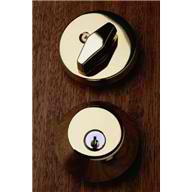
If your residential deadbolt cylinder just spins around when you try to use your key, that can because of a number of factors.

If you have a Kwikset deadbolt, a spinning means
  1. The part of the the tailpiece where it is attached to the deadbolt and held on by the clip, has shattered.
  2. The clip that holds the tailpiece on has shattered.
  3. The clip has just come off slightly
Go to your local hardware store.  In the event you cannot find parts, a new Kwikset deadbolt is not very expensive.  Just use the parts in the box and retain your existing keyed cylinder.

If you have a Callin deadbolt, s spinning cylinder means
  1. The deadbolt mechanism that retracts and inserts the actual bolt may have shattered.  In this case, the thumb turn or key will travel a partial distance without affecting the bolt.
  2. The tailpiece, which is held on by a threaded nut, has shattered.
Replace the parts by buying a new deadbolt.  These locks, though they look wonderful, are of extremely poor quality.

The newer Schlage deadbolts do not appear to me to be having any problems.  The tailpieces on these deadbolts are held onto the deadbolt be threaded nut.  In the event there is breakage, call you local locksmith or better hardware store.  Sometimes hardware stores have a parts box that may have the piece you are looking for.

Sunday, December 11, 2011

My Deadbolt Key Turns But Nothing Happens

If your key just spins around in your deadbolt without activating the bolt, then the tailpiece of the deadbolt is probably broken. If your lock is a Kwikset deadbolt, the clip that holds the tailpiece may have been thrown due to lack of lubrication. There is also a chance that the clip has shattered, though more than likely the clip just slipped off. Here is what to do:
  1. Remove the deadbolt. If it is a Kwikset, it can only go on one way.
  2. Check the clips and tail piece. If the clip is still barely in place, then the clip just needs to be pushed back into place. Shoot it with WD-40. Reinstall.
If you have any other brand that does not use a clip, you will notice that the tailpiece has been sheared off at the cylinder. Deadbolts are east to install. Go to Lowe's and ask the attendant to give you a deadbolt and have him match it to your old key.

Often, Kwikset clips come off because of lack of lubrication. Sometimes it is caused by a poorly placed drilled hole in the latch area. If you suspect that the installation holes were improperly drilled, buy a new type of deadbolt that utilizes a different style tailpiece. Go to the locksmith store and request a US Lock or LSDA deadbolt. These can be keyed to Schlage or Kwikset/Callin. Whereas Kwikset requires a near perfect hole cut out in order to work smoothly, the LSDA and US Lock residential deadbolts are designed to operate even if the doors are not drilled dead on.

My Door Knob Unlocks Itself! Testing The Kwikset & Callin Lock For Integrity

If your house doors have Kwikset or Callin locks, do know that, over time, the return springs break. Of course, if you turn your knob it will spring back into place because the latch spring is activating; but it will be a weak return and anybody will be able to open your door even if you lock it. If you suspect that your house lock is unlocking itself, or becoming unlocked when it is locked, here is a simple test you can conduct.
  1. Lock the knob or lever.
  2. From the outside, try to open the lever or lock by turning it hard and quickly form left to right about ten or twenty times. Back and forth, back and forth, back and forth.
  3. If the return spring is broken, the lock will unlock itself, allowing you to enter.
The danger in this is that your lock will be locked when you lock it, and you will think you are safe; but quick jiggles will unlock it from the outside. Any stranger who discovers this will have easy access to your home and you will never know it.

Just take your key down to the hardware store, ask the man in the lock department to provide you with another lock and ask him to key the lock up to your old key.While you are there, ask him to show you how to remove and install the new lock.

Wednesday, December 7, 2011

Callin Residential Lock Latch Locks Up - Remove and Replace

Callin makes a beautiful lock. However, the latches are prone to jamming in such a way as to render your door inoperable. No matter what you do, whether you unlock it with the key or turn the inside and outside knob or lever, the door simply will not open. Here is what you can do:
  1. Have a flat head screw driver, a hammer, and a pair of vice grips ready.
  2. First, try to pry the door away from the jamb. Be careful not to go to far with this or you will mar your door and jamb, necessitating cosmetic repair. If this works, then remove the lock entirely and replace the latch with a new Kwikset latch from the hardware store.
  3. If the door is too tight, remove the interior screws of the lock and remove the inside knob/lever. The outside knob will be locked into place because the latch is jammed. If you can remove the locking spindle (that is the tube-looking spindle that has a hole in the end which the interior knob turn-button inserts into) then you can remove the knob. I cannot in words describe how to do this. But there is a catch either at the 12 or 6 o' clock position underneath the spindle that is spring loaded. Turn the spindle half way between left and right with the tip of a 32 regular Phillips driver, lift up on the catch and hold it there, and slip the spindle out. If you are lost at this point, destroy the lock spindle where it joins the lock body. Just pry it apart. Just get the outside knob off!
  4. Now you have to deal with a jammed latch. This may take some time. With your flat head driver, carefully destroy the latch so all the parts and guts come out. You may need a hammer to get started. Just use your flat head driver to pry the latch apart. Once all the parts are gone, you should be able to use a small driver to pry the latch back. The door should open. 
  5. This may take you from 15 minutes to one hour or more. Replace the lock with another Callin, but buy an optional Kwikset latch.

Monday, October 31, 2011

Your Door Bounces Off the Jamb Instead of Latching

All of us just swing the doors until they close. But sometimes, the slam against the strike plate and bounce open. Then we go back, turn the handle and close the door manually. So, what is wrong here? The solution may be easy.
  1. First, using WD-40, lube the latch on the lock. Shoot it in but do not let it drip all over your floor. Swing the door shut gently without touching the knob. This usually does the job.
  2. If after you lube the latch the door is still bouncing off the strike plate, the the latch is bad. Get the name off the latch and go to Lowe's. Either buy a new lock and have the attendant key it to match your key, or just buy the latch.
  3. Do not forget to check the strike plate to see if it is in the correct place.
  4. If the latch is broken, and you have a Kwikset lock, your door could get locked up.

Friday, October 21, 2011

Keying Locks To Match

After searching my business website, www.a-bestlocksmith.com, I have noticed one question that is asked quite often. That question is, "Can I make the keys match on my Schlage and Kwikset locks?" The short answer is "No". But that does not mean you cannot have all of your house locks on one key just because they are different brands. Consider some of the following points if you wish to have your locks match.


  1. If you want to have your locks all match one key, try this simple test. Take the key that operates your best lock and try it out on every lock in your home. You are not looking for the key to operate the lock, you want to know if the key will go into the lock. If the key goes in, then that type of lock is compatible with the key you are using. Hire a locksmith and ask him to key them to match.
  2.  Kwikset, Callin, EZ Set, some Baldwin, Weiser, Falcon, Defiant and others are compatible on the same type of key. Schlage will not be part of this set.
  3. Schlage locks, though popular, have their own key way. It is referred to as Schlage C, or SC1. Except for commercial after-market manufacturing, there are no residential imitations that use that key way. Kustom Key online does offer a Schlage C cylinder that can be used in the bottom-line Kwikset knob. But they ship out of the west coast and you will need a special tool and some know-how in order to make the change. Besides, Kwikset is going over to the Smart Key system and this lock will not accept the Schlage keyed cylinder that is offered. So, my advice is to either buy more Schlage Locks at Lowe's or buy all Kwikset.
  4. The easiest way to match your locks and keys are to determine which locks are in the best condition and are most numerous. Then, go to Lowe's, give your key to the salesperson, and ask him to key up the appropriate locks you need. He will also be glad to illustrate for you how to remove and install the locks.

Tuesday, October 18, 2011

House Locks Are Not Locking Into the Jamb Properly

You should always test your doors in order to make sure that your lock latches and bolts are lining up with the strike plates in the door jamb. The reason for this is because 1) houses settle and move over time and 2) the weather will cause wood to shrink and expand. Here is how you check your latches and bolts.

  1. Standing on the inside, close you your door and notice where the knob latch hits the plate on the door jamb. It should be dead center. If it hits off center and still locks, then you are still okay for the moment. You may need a flashlight.
  2. Throw your deadbolt and verify that it is entering the plate dead center.
  3. If everything looks okay, try this next test. Close the door gently. Look and listen to determine that the knob latch has clicked into place. Operate the deadbolt. If you have to close your door with a slam to get the latches to line up properly, that is not necessarily a bad thing. Over time, however, it may become an issue.
  4. Check your hinge screws and make sure they are snug. If they are loose, they can cause the door to sag and the locks to lose their alignment. If your screws are stripped, get 3 inch long sheet rock screws and replace two in each hinge on the jamb. This will often pull the door up and realign the latches. If this doesn't help, proceed to the next section. But, by all means, tighten the hinge screws!
How to realign your strike plate. (Tools needed: Phillips screwdriver, wooden golf tees, pencil, hammer, and 1 inch wood chisel from Lowe's).

  1. Using the above instructions, determine whether or not you need to raise, lower, set back, or move forward the knob strike plate.
  2. Remove the strike plate.
  3. Reposition the strike plate where needed and outline the place with a pencil.
  4. Using your wood chisel and hammer, chisel out the wood by first outlining the marks you made with the pencil, and then chiseling out the wood itself.
  5. Use golf tees to fill in the old screw holes. Just gently hammer them in until they are snug and then snap them off flush with the jamb.
  6. Replace the strike plate and fasten with screws.
  7. Follow the same procedure with the dead bolt strike plate.

Sunday, October 16, 2011

Home Invasion Prevention

It has been said that one in five homes have experienced a home invasion. A home invasion is not like a burglary, which takes place when you are away. A home invasion is when someone comes into your home when you are there. Let's face it: none of us is immune to having our home invaded. It does not mater what neighborhood you live in, either. Upscale or slum, you are a target.

I have one female client in Murfreesboro, TN, who had a few home invasions. When she moved into her new home, which was a foreclosure property, she never had the locks changed. For a period of 6 months, she had this feeling that someone was entering her home. One evening, while she was sleeping, someone entered her home with a key. What woke her up was the sound of the creaking rail leading up the stairs. Luckily, she awoke and startled the invader, who fled. Now, imagine being a single woman and waking up with a man standing over you.

Here are some precautions you need to take.

  1. Always have your house locks re-keyed when you move in and never leave a key outside under one of those fake-looking rocks. Criminals know where all the hiding places are.
  2. Get a dog or make it look like you have have a dog by putting a beat up dog food bowl at the front and rear doors.
  3. Get motion-activated lights put up on the front, rear, and sides of your home.
  4. You can get a house alarm, but not everyone can afford one. Instead, get a stand-alone, motion-activated, infrared alarm. This would be a portable alarm. If you sleep upstairs, put it at on the wall where an intruder would begin to ascend the steps. You can check out the Infrared Portable Motion Alarm (HS5300) Digital Keypad 105db Siren online. In fact, I think Lowe's sells one for $27. Also, go online and buy the big mace sprayer. This unit is huge, costs around $50, but will take out a bunch of people quickly. When your motion alarm goes off, grab your mace, head for the stairs and, if the criminal is still there, hose him down. 
  5. Make sure you have deadbolts; but do not rely on them. They can be easily kicked in. I will soon be offering an invasion deterrent lock on this site.
  6. If you would like, take a self-defense course and weapons training. The best home defense weapon is the shortened 12 gauge shotgun. I would recommend the new Keltec semi-automatic shotgun. I think it has 18 shots and fires just as fast as you can pull the trigger!
  7. Install a nanny-cam self-contained DVR camera. They come in different configurations. You can even get one that looks like a tissue container. These devices are motion-activated, coming on only when they detect motion.

Friday, October 7, 2011

Kwikset Smart Key Bump Resistant Review

Kwikset is my favorite lock for low-cost residential applications.  In fact, I re-key them more often than any other house lock.  The new Kwikset Smart Key system is a wonderful concept in lock keying technology.  These locks are difficult to pick open, and that is a good thing. Once they are installed, you can re-key them yourself by going to Lowe's or Home Depot and asking for the Smart Key re-keying kit, pictured above.  When you decide to re-key these, be sure that you do not have any distractions because you want to do this accurately. Here is how you re-key these.

1.  Get the re-key kit and have any duplicates made while you are at the hardware store.
2.  Insert your old key, turn it 90 degrees to the right and stop. It does not matter if the lock is installed upside down.
3.  Insert the tool and push until your hear/feel a click. Remove tool.
4.  Without moving the key in any direction, remove it. Use your thumb to hold the key cylinder in place.
5.  Insert the new key in the same position in which you removed the old.
6.  Turn the new key back in the opposite direction and work it back and forth.

Do note that there have been some problems in the past with this system.  I have had calls to houses where one year old locks were not serviceable.  Fun, fun, fun!

In the event you mess it up and the keys no longer work, a locksmith can use a special tool to reset the lock. However, locksmith rates being what they are, just go and buy a new lock and have the guy at Lowe's set the new lock to the key you give him.

Thursday, October 6, 2011

"Why does my door bounce off the strike plate when I try to shut the door?"

The latch is dry and needs a shot of WD-40.  If this does not work, the latch is broken.  You can go to your local hardware store and buy the proper latch.  Ask the salesperson to show you how to do this.  Before going, however, be sure to read the name of the lock from the face of the latch itself.  It may say Schlage, Kwikset, Callin, EZ Set, or Baldwin.

"Why do I have to 'jiggle' my keys in order to get the lock to work?"

Your key does not work properly because you are using a poor copy or a copy that has been made from a copy.  Keys are much like copier copies: whenever you copy a copy of a copy, you get poorer and poorer results.  Similarly, no key machine copies perfectly. As a key moves farther away from the original, the less accurate it becomes.  It could also be that your key tumblers have been worn down. Solution:  Find the original factory key and make copies from it.  If you cannot find one, you may need to re-key the lock.  Always ask your locksmith for a "factory original" when he re-keys.  Also consider whether or not your locks are old and worn. Sometimes the key-way itself is worn out and the key has too much wiggle room and cannot seat itself properly in order to activate the tumblers.