Showing posts with label Lock Cylinders. Show all posts

Wednesday, November 9, 2011

Murfreesboro, Tennessee Locksmith Rates

In Murfreesboro, Tennessee, you can expect these kinds of rates for locks service. First, I will list the rates that A-Best Locksmith charges.
  •  Service call $45 - $50
  • Price per lock cylinder to re-key - $13 to 17.50
  • Car opening - $55 (I pay the sales tax!)
  • Safe recombination - $125 to $150
  • Grade 2 commercial door lever - $150 installed
  • Deadbolt installation - $50 if lock provided by customer, $75 if I provide the lock
  • Open home - $65 to $75
  • Door Closer - $195 for basic grade 1 overhead surface mount, $395 for concealed closer
Here are what my competitors charge
  1. Car Opening - $45 to $75
  2. Basic Service Call - $45 to $60
  3. Lock re-key per cylinder $13 to $18.50
  4. Grade 2 commercial lever - $185 by one locksmith

Wednesday, November 2, 2011

Re-Keying Your Front Glass Door Swing Bolt Lock

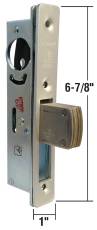
If you have a a #2 Phillips head screwdriver and a small flat head driver, then you can re-key your own front glass door. When I say "re-key", I mean removing the round cylinder and replacing it with a new one. Go to your better hardware store, not Lowe's, and ask for a 1 inch mortise cylinder with the Adams-Rite Cam. Have extra keys made and test them. Here are the steps in the change-out process
  1. Remove the lock face plate on the side of the door. Usually held in with three Phillips head screws.
  2. Look for two more Phillips head screws, one at the top of the lock and one at the bottom. Loosen these just enough so that the bolt body wiggles a bit.
  3. Look for two sunken flat head set screws opposite each lock cylinder. Look closely. Each cylinder will have one. (Your door does have two cylinders, one inside, one outside.) Loosen these by about three turns, just so you can grab the cylinder you are changing and unscrew it.
  4. Unscrew the lock cylinder. You will notice from the new one you purchased that the cylinder is threaded.
  5. Take the spacer off the old lock and put it on the new one. Reinstall lock.
  6. Do note that, if you screw the lock in too far, the cam may bottom out on the Adams Rite bolt workings inside the door. If you do this, you will feel the key grind as you turn it. If it is grinding, back the cylinder off by one turn.
  7. Options you can add to this job are lubing the inside of the Adams Rite and adding an anti-wrench collar in place of the standard collar.
  8. Reinstall the set screws, tighten the two top and bottom screws, reinstall the face plate. You just saved yourself $70.

Monday, October 24, 2011

Key Will Not Come Out Of Lock

When your key is getting harder and harder to pull out of the lock, it will eventually get stuck for good. This problem occurs mainly on store front glass doors where an Adams-Rite style bolt or latch is used. Of course, it can occur on some panic bar rim locks and commercial grade knobs and levers, though I do not see this very often. So, let's get that key out the lock so you can go home for the night. The locksmith can wait until tomorrow when you may be able to get a better service call rate! Here is what every manager and key-holding employee should know.
  1. Stand on the outside facing the lock. Your key is stuck in the lock. First, be aware that a key can only be removed in the position in which it was inserted. Usually, this will be with the cuts of the key facing upwards directly at 12 o'clock. (Some automatic sliding glass doors have the entire lock system upside down, however. So, in that case, the key cuts will be pointing to 6 o'clock.) Note that when you try to pull your key out, that small round part of the lock the key is inserted into is trying to come out with the key. This is causing the tumblers to bind and hold the key. You will have to relieve this pressure in order to remove the key.
  2. If you are leaving for the night, turn the key and lock the door.
  3. Now, grab the key with your right hand. With your left thumb, push in on the small round part of the lock into which the key is inserted. Your thumb will be right up against the key. Now, with the key in the correct position (12 o'clock), push the small round part in with your thumb and "wiggle/pull" the key out. In the morning call your locksmith to tighten the screws on the back of the mortise cylinder.
There are some other scenarios that can cause your key to get stuck. If you use your key to pry open things, then the tip gets bent. Your key is bent if it is hard to insert. Have a new key copied. Sometimes, some one has inserted a device into your lock thinking he or she could force the lock open. Again, your key will be hard to insert. At restaurants, people usually stick toothpicks into the locks. At clothing store, people stick straight pins into the key cylinder.

Saturday, October 15, 2011

Thumb Turn In Commercial Glass Door Will Not Turn

Notice the photo on the left. This is a thumb turn made by U.S. Lock. Notice also that you can see holes on the top. Also imagine that dirt dobbers make nests in your hollow aluminum door and that, as the door is used, debris falls into the holes and jams the lock. Be sure to always ask for a thumb turn that has a cap on the cylinder holes. Sometimes, however, the thumb turn quits and dirt dobbers are not the problem. If your thumb turn is hard to turn, and you feel a grind, you can do these things. (Also note it is threaded and has a set screw channel.)

  1. Look at the thumb turn on the inside of the door. Spray WD-40 around the actual thumb piece so the oil will penetrate into the thumb turn. Be sure to have a paper towel ready. (If you feel grit, read below, unscrew the turn all of the way out and flush it with WD-40.)
  2. If the thumb turn still grinds, loosen the three screws holding on the lock plate on the edge of the door. Now, where you see the thumb turn, imagine it as if it were a clock. At 9 o'clock, or 6 o'clock, on the edge of the door where you see the lock body, you will see a small, countersunk set screw. Unloosen it two or three turns only. Make sure the thumb turn is in the open position. That means, when you turn the thumb turn, you will feel it grab slightly with a spring and ball bearing. This holds the turn in open position. The turn itself will be pointing to 6 and 12 o'clock. If you do not feel the bearing, then turn the thumb turn 180 degrees, or just reverse it. (The lock cannot be removed if it is not in open because a lock cam is trying to activate the lock and hangs down into the lock, barring any attempt to remove it.)
  3. With the set screw loosened, grab the outer body of the thumb turn and turn it counter clockwise, unloosening it, one complete turn.  If you cannot move it, simply unloosen the two lock screws on the edge of the door that hold the bolt in. Tighten the set screw, tighten the lock screws, test the thumb turn. If this doesn't work, go to a better hardware store and buy a new turn. Locksmith's buy these for $6.00 and install them for $75 to $125.