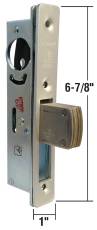
Showing posts with label Glass Doors. Show all posts

Saturday, February 25, 2012

When Your Key Will Not Come Out of Your Lock

It often happens that, when a manager tries to leave the business for the evening, that the key gets caught in the front glass door lock. If this happens, look closely at the lock and you will notice that the plug into which the key is inserted, which is the part of the lock that actually turns with the key, is trying to come out with the key.  Look closely.  This is happening because the two tiny screws on the back of the lock are loose and this looseness is allowing the plug to come out of the lock outer shell just enough so that the tumblers in the lock get jammed.  When the tumblers are jammed, the key is held captive.

There is no need to call the locksmith for a night call.  Here is what you do. Turn the key to the position where it normally comes out.  This will usually be where the cuts of the key, or the "teeth" of the key, are pointing to the 12 o' clock position, or are in the "up" position. 

Now, while using your thumb to hold the plug in place, you can now remove the key with ease.  Just make sure that your thumb is pushing inward on the plug enough to relieve the pressure on the key.  You may have to turn the key right and left just in small increments in order to be sure that the key
comes out in the exact upward position.  In the morning, call the locksmith.

Wednesday, November 23, 2011

Replace the Stock Cylinders That Come With Your New Commercial Glass Door

If you have a commercial glass door, and it is a newer door, chances are there are stock, glass door lock cylinders installed. Of course, you pay quite a hefty sum to have these doors installed; but the truth of the matter is that the lock cylinders that come with it are "dollar-trash" locks cylinders. If the lock cylinders are newer, then the keys will work okay for a while. If you try to re-key them, and the locksmith uses some deeper cuts in the key, the tumblers will just refuse to operate properly. If you have had these cylinders for a while, it is best to ask your locksmith to install solid brass cylinders on his next visit. Here are some things you should know about the lock cylinders that come with your glass doors.
  1. The are made of cheap metal and are die cast. They are not finely machined brass. Die cast metal tends to corrode more easily than brass.
  2. The tailpieces or cams cannot be held on to the cylinders as tightly. Eventually, the screws work themselves free and jam the lock. I have seen this too many times to remember.
  3. The cams on these locks are often die cast material of inferior quality as well. If you have to force the key to lock the bolt, the pressure can be enough to shatter the cam, causing a lock out.
  4. The Adams- Rite set screws which hold the lock cylinders in place just never hold very well, causing the lock cylinders to spin freely when you turn the key.
  5. It seems that, over time, the tumblers wear a pattern into the cylinder plug and make accurate re-keying impossible. If you insert your key into the cylinder and it hesitates before turning, your lock has a wear pattern and the top pins are not falling correctly into the chambers.

Thursday, November 17, 2011

A Murfreesboro Locksmith Does Shoddy Work and Lies to Customer

I received a call from a new client on St. Andrews Street in Murfreesboro, TN. The manager called me over to look at her Adams-Rite dead latch and exit paddle. There was no faceplate on the Adams-Rite lock mechanism. The manager asked the locksmith about the absence of the cover plate and he replied that the lock does not come with a cover plate. He could not fool the manager, however. I was called to tighten the lock, which was falling out of the door, and install a make-shift cover plate, which looked so good the manager decided to just keep the plate and not have me come by and install the "correct" plate. When it comes to glass door dead latches, the face plate plays a vital role in keeping the lock centered. Without it, the lock moves in the door and the activation plug of the paddle falls out, disabling egress.

Remember: if the completed lock service does not look right, then it isn't right. This is especially true when it comes to glass storefront doors. Demand that your job be done properly. If it isn't done properly, refuse to pay.

Friday, November 11, 2011

Replacing a Commercial Glass Door Pivot Doesn't Make Any Sense

If you have a commercial glass door with a pivot on the top and bottom of the door, do know that they wear out! In fact, you can test the integrity of the pivot system by opening the door and pushing against the door from the lock side. You will probably notice the pivots moving. If you see this, there are a few possible reasons.
  • The pivots are worn out
  • The screws holding the pivots to the jamb and door are loose
Pivots, as compared to after market continuous hinges, are not very strong. I have seen customers have their doors blown off by wind! If the pivots are bad, here are some associated problems.
  • Door leans from the top
  • Lock bolt does not catch properly in the strike cut out
  • Top pivot actually fails and door falls out of the upper portion of the pivot
  • Door drags on thresh hold
Here are some things you can do that may help fix your problem.
  • Get a ladder and a set of open ended wrenches, tighten the bolts inside the hollow part of the door at the top
  • At the top, tighten the three Phillips screws
  • Check the bottom pivot. If it has a flat head type screw on the top, you can adjust the door by removing that screw. Down in the hole, there is an Allen wrench screw. If you tighten it, the door will elevate and eliminate dragging and realign the lock and strike. If the door is to high, seldom a problem, lower it by turning the screw counter clockwise
If the pivots will not adjust or tighten, then opt for a continuous hinge. This hinge runs from the top of the door and runs all the way to the ground, distributing the weight of the door equally along the entire door. Most hinge companies guarantee their hinges for the life of the opening, except for vandalism. A-Best Locksmith can install a continuous hinge on your door, if the application is standard, for $395 total. Expensive? Yes. But you will not have to worry about the door again!

Wednesday, November 2, 2011

Re-Keying Your Front Glass Door Swing Bolt Lock

If you have a a #2 Phillips head screwdriver and a small flat head driver, then you can re-key your own front glass door. When I say "re-key", I mean removing the round cylinder and replacing it with a new one. Go to your better hardware store, not Lowe's, and ask for a 1 inch mortise cylinder with the Adams-Rite Cam. Have extra keys made and test them. Here are the steps in the change-out process
  1. Remove the lock face plate on the side of the door. Usually held in with three Phillips head screws.
  2. Look for two more Phillips head screws, one at the top of the lock and one at the bottom. Loosen these just enough so that the bolt body wiggles a bit.
  3. Look for two sunken flat head set screws opposite each lock cylinder. Look closely. Each cylinder will have one. (Your door does have two cylinders, one inside, one outside.) Loosen these by about three turns, just so you can grab the cylinder you are changing and unscrew it.
  4. Unscrew the lock cylinder. You will notice from the new one you purchased that the cylinder is threaded.
  5. Take the spacer off the old lock and put it on the new one. Reinstall lock.
  6. Do note that, if you screw the lock in too far, the cam may bottom out on the Adams Rite bolt workings inside the door. If you do this, you will feel the key grind as you turn it. If it is grinding, back the cylinder off by one turn.
  7. Options you can add to this job are lubing the inside of the Adams Rite and adding an anti-wrench collar in place of the standard collar.
  8. Reinstall the set screws, tighten the two top and bottom screws, reinstall the face plate. You just saved yourself $70.

Thursday, October 27, 2011

Store Front Glass Door is Hard to Lock and Unlock

If your key is working fine when the door is open but is very hard to turn when locking or unlocking the door, then the problem is not in the lock. There are three things to check for.
  1. First, check the threshold and make sure there are not any small rocks or other debris that are being squeezed by the door. When debris is present, you have to push the door in order to get the bolt to lock AND push the door to get it to unlock. What you are doing is relieving the pressure from the bolt enabling it to operate. Remove any debris and repair any screws that may have risen in the the threshold.
  2. Second, if your door or door frame has settled, then the bolt receptacle in the jamb and the bolt are not lining up. Specifically, the bolt is too high and is stopping prematurely by hitting the top of the jamb cut out. Yes, it will lock when it is like this, but you will notice by using a flashlight that the bolt is hitting metal before it goes through the complete cycle. Take a small round metal file which you can get at Lowe's and file to top of the cut out and give the bolt another quarter inch within which to move. 
  3. Third, if the door is warped, you have to push in on the door in order for the bolt to engage. Using a metal file, file the part of the jamb bolt slot nearest you on the outside enlarging the hole.

Tuesday, October 25, 2011

Lock Cylinder Spins in Circles and Will Not Lock or Unlock Door

When you insert the key into the lock cylinder, only the plug into which the key is inserted is supposed to turn, thereby unlocking the lock mechanism. However, sometimes a set screw comes loose and the entire lock begins to turn in the door. Here is what you can do to fix this and save that $75 locksmith fee.
  1. Look at how you neighbor's lock cylinder is situated on the front door. On most doors, the key is inserted with the cuts of the key facing up. It is in this 12 o'clock 6 o'clock configuration that you want your lock to conform to.
  2. Unloosen the three Phillips screws on the side of the door where the lock is located. Pry this plate off if it is tight.
  3. Using a small flat head driver, further unloosen the countersunk set screw opposite the lock cylinder. Do not remove it, just loosen it. Turn the lock cylinder to the proper position. Tighten the set screw.
  4. Sometimes, however, you will have to unloosen the two large screws at the top or bottom of the main bolt lock body in order to give the cylinder some wiggle room. When all is set into place, tighten everything. Reattach plate. Test keys and locks. While you are at it, shoot some WD-40 into the bolt.
  5. Also, you will not be able to turn the cylinder if your key is inserted into the lock and turned. The reason is that the cam on the back of the lock is jamming the lock.. If your key is inserted into the lock, you will to turn the cylinder towards where it should be while trying to gently turn the key to where it should be when inserted. You just have to juggle this to get it where the key will come out. Remember, if the key hole is not set to the correct clock position, the key cannot be inserted or retracted.

Saturday, October 15, 2011

Thumb Turn In Commercial Glass Door Will Not Turn

Notice the photo on the left. This is a thumb turn made by U.S. Lock. Notice also that you can see holes on the top. Also imagine that dirt dobbers make nests in your hollow aluminum door and that, as the door is used, debris falls into the holes and jams the lock. Be sure to always ask for a thumb turn that has a cap on the cylinder holes. Sometimes, however, the thumb turn quits and dirt dobbers are not the problem. If your thumb turn is hard to turn, and you feel a grind, you can do these things. (Also note it is threaded and has a set screw channel.)

  1. Look at the thumb turn on the inside of the door. Spray WD-40 around the actual thumb piece so the oil will penetrate into the thumb turn. Be sure to have a paper towel ready. (If you feel grit, read below, unscrew the turn all of the way out and flush it with WD-40.)
  2. If the thumb turn still grinds, loosen the three screws holding on the lock plate on the edge of the door. Now, where you see the thumb turn, imagine it as if it were a clock. At 9 o'clock, or 6 o'clock, on the edge of the door where you see the lock body, you will see a small, countersunk set screw. Unloosen it two or three turns only. Make sure the thumb turn is in the open position. That means, when you turn the thumb turn, you will feel it grab slightly with a spring and ball bearing. This holds the turn in open position. The turn itself will be pointing to 6 and 12 o'clock. If you do not feel the bearing, then turn the thumb turn 180 degrees, or just reverse it. (The lock cannot be removed if it is not in open because a lock cam is trying to activate the lock and hangs down into the lock, barring any attempt to remove it.)
  3. With the set screw loosened, grab the outer body of the thumb turn and turn it counter clockwise, unloosening it, one complete turn.  If you cannot move it, simply unloosen the two lock screws on the edge of the door that hold the bolt in. Tighten the set screw, tighten the lock screws, test the thumb turn. If this doesn't work, go to a better hardware store and buy a new turn. Locksmith's buy these for $6.00 and install them for $75 to $125.

Thursday, October 13, 2011

Commercial Glass Door Deadbolt Unlocking Itself

No, you aren't imagining things when you show up on Monday morning and your front commercial glass door is unlocked and there has been no apparent burglary. The Adams-Rite deadbolt, or the generic equivalent, is a laminated steel bolt that usually swings upward into the locked position when you turn your key. When you lock this lock, you should flip your key hard at the end turn and listen for the "ker-plunk"! You want to hear that bolt banging into position and you want to hear it deadlock.

If you find that the bolt is unlocking itself but you aren't quite sure, you can perform two tests.


  1. Lock the door and check that the bolt is locked. Grab the outside handle and rattle and shake the door as if you were trying to open it. Watch and see if the bolt is beginning to drop.
  2. With the door open and in the unlocked position, insert your key and turn it very, very slowly. You do not want the "ker-plunk". Watch the bolt and listen. As your key nears the final motion, the lock will either "click" into place or fall back down. If it clicks into place, take your hand and try to force it down. If it doesn't fall, then your lock's spring is okay. Retest. If it falls, it needs replacing. Ask your locksmith for the generic brand, which costs the locksmith around $15. If he sells you the Adams-Rite brand, he will pay three times as much and charge you accordingly. 
  3. A good price for a standard install of this type might be $95. While you are at it, make sure your lock cylinders are in good shape. If not, have them replaced. A key on the outside and a thumb turn on the inside.

Wednesday, October 12, 2011

Lock Spins in Commercial Glass Door

If you a have a commercial glass door with a lock cylinder that is about 1 inch in diameter, you will have loosening. This happens because your door is being used! Not a bad thing! But, vibration causes all kinds of issues in doors and locks. Here is what you can do if your lock is spinning in the door. You will need a Phillips Screw Driver and a small, flat-head driver.

  1. Walk over to one of the businesses next to you and observe the position of the cylinder. You will note that the key insertion point is probably at the 6 o' clock position exactly. (Some door have in at 12 o' clock, but it is rare.) Also, make sure you are not looking at a door on the business where the lock cylinder has been turned upside down in order to disable the key operation on the outside. If in doubt, ask the store manager. 
  2. Open your door and look on the door edge and you will see a cover plate with three screws in a vertical line. Using a screwdriver, remove these screws and remove the plate.
  3. Look for a small, black set screw that sits flush into the lock, right next to the cylinder that is loose. Back the screw out counterclockwise two turns, but do not remove it.
  4. Grab the cylinder. It is a threaded lock cylinder and it screws in and out like a regular screw. Turn the lock to where the key insertion point is sitting right a 6 o' clock.  Tighten set screw. While you are at it, tighten both. You will see them side by side.  Replace plate.
  5. Since you are servicing the lock, take WD-40 and shoot the key hole. Also, with the deadbolt in the partially "out" position, angle the WD-40 can into the bolt hole and aim in up into the lock where you guess the back of the lock's key cylinder would be.