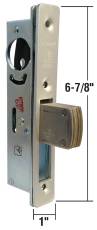
Retrofitting Narrow Stile Storefront Doors: From Adams-Rite Swingbolt to Deadlatch
By David Calvin
Available at Amazon Books. Click the title!
Aluminum, narrow stile, glass doors are everywhere! In fact, I've made a mint servicing them over the years. I install continuous hinges on them, rekey the locks in them, replace the thumb turns in them, replace the lock bodies, lubricate them, and install door closers on them. But when it comes to replacing the Adams-Rite Dead Bolt or Hook Bolts with the Adams-Rite Dead Latch, I'm making a great profit for less than two hours work.
So, just how bad is the money? I buy aftermarket parts. The latches are $15, the levers are another $15, the Adams-Rite strike is another $15. Okay - if I am installing a paddle, those run around $30. So, for $50 worth of lock hardware, I get a $65 service call and up to a $295 install. If I have to install a door closer while I'm there, it's another $100 profit. So, gee - this is really bad, right? I quote the job, I get the job, I get half a trip to Cancun out of it. But who the heck wants to go to Cancun, right? I don't.
The big question is this: can you use a drill, a screw driver, and do you know how to thread a drilled hole with a tap? You can.
So, what's the deal? Well, for starters, I hate instruction manuals, especially the ones written in China. So I will tell you right now that installing the Adams-Rite knock-off dead latch is more art than - hmm - science and math.
And why do people want a dead latch anyway? Because they want their storefront glass door to close back and LOCK every time somebody comes in by key or leaves by lever. And you need to know how to do this and not be like the locksmiths who runs from such jobs.
My book, which is full of pictures, tips, and know-how, will get you off and running. No, this book is not a field manual. This is a book you read through three times and then hit the road. The same as my other book, The Locksmith's Lever and Panic Bar Retrofit Book.
I am sorry to say that we will not offer this book in print for a number of valid reasons. You can buy this book, read it on your computer via the Kindle app, or read it on your smartphone or Kindle tablet.
And yes - I include my email address and website information so you can email or even call me.
And do call me! -- Happy hunting! -- You can do this!
A-Best Locksmith reveals wholesale costs, do-it-yourself information for commercial and residential lock problems, scam issues, and common-sense security steps you can easily implement.
Showing posts with label Adams-Rite. Show all posts
Monday, March 20, 2017
Thursday, September 19, 2013
Practical Advice Regarding Glass Exit Doors and Thumbturns
Sometimes, I receive a call from a customer who wants to have an additional swing-bolt lock installed on the front door of their business. Of course, there is always a lighted exit sign above the door which identifies this door as an emergency exit.
You cannot put two locks on a door that is designated as an emergency exit. Why? Because, in the event of an emergency, the emergency exit door must be able to be opened with one motion. If there are two locks on the door, an person leaving the building will have to use two motions to leave the building. This, as you can see, could be problematic. Imagine, for example, that a disgruntled employee starts shooting after closing time. Having to unlock two locks could mean the difference between life or death for a person trying to escape such a situation. Imagine that a door does have two locks and that one is unlocked and the other locked. In an emergency situation, a person trying to leave the building will unlock the locked lock and lock the other.
You must have thumb turn on the inside of your door if the door is a glass door using the Adams-Rite deadbolt. In the event of an emergency, the person leaving the building can unlock the door in one motion. However, the thumb turn is not intended to be used in banks, for the reason that bank robbers can conveniently lock the doors behind them. Also, it seems to me, a person who runs a business alone should be exempt from the thumb turn requirement. It could happen that a person wanting to commit a crime could easily enter, lock the door behind him, and proceed with his crime.
Although codes exist for good reasons, it is simply absurd for the local governing authorities to uphold codes if there are valid reasons why a code should, and must be, ignored. In the event you have question on one of these issues, call your governing authority (perhaps your local fire marshal), tell him about your concerns, and ask him or her to waive the rule. But, if he or she rules in your favor, be sure to get it in writing.
You cannot put two locks on a door that is designated as an emergency exit. Why? Because, in the event of an emergency, the emergency exit door must be able to be opened with one motion. If there are two locks on the door, an person leaving the building will have to use two motions to leave the building. This, as you can see, could be problematic. Imagine, for example, that a disgruntled employee starts shooting after closing time. Having to unlock two locks could mean the difference between life or death for a person trying to escape such a situation. Imagine that a door does have two locks and that one is unlocked and the other locked. In an emergency situation, a person trying to leave the building will unlock the locked lock and lock the other.
You must have thumb turn on the inside of your door if the door is a glass door using the Adams-Rite deadbolt. In the event of an emergency, the person leaving the building can unlock the door in one motion. However, the thumb turn is not intended to be used in banks, for the reason that bank robbers can conveniently lock the doors behind them. Also, it seems to me, a person who runs a business alone should be exempt from the thumb turn requirement. It could happen that a person wanting to commit a crime could easily enter, lock the door behind him, and proceed with his crime.
Although codes exist for good reasons, it is simply absurd for the local governing authorities to uphold codes if there are valid reasons why a code should, and must be, ignored. In the event you have question on one of these issues, call your governing authority (perhaps your local fire marshal), tell him about your concerns, and ask him or her to waive the rule. But, if he or she rules in your favor, be sure to get it in writing.
Labels:
Adams-Rite,
Codes,
Doors,
Exit Signs,
Exits,
Thumb Turns
Sunday, January 1, 2012
Door Closers Designed With A Door Hold-Open Feature Are Perfect For Churches and Organizations!
If you have a commercial business, church, or other organization that needs to have outside doors that stay opened, look no further than door closers that incorporate a hold-open feature. It is generally not a good idea to use door kick stops that have the little rubber foot attached. Why? Because most of these cannot hold up to the abuse they will get when people kick them or otherwise impact them when hauling chairs and tables through the doorway. And, if your doors are made of thin metal, the screws will eventually strip out. It is also a bad idea to use any kind of device that anchors into the concrete sidewalk because people will inevitably trip over the device and hurt themselves.
If you need to have your doors in the hold-open position, install a heavy-duty door closer. LCN makes a wonderful product that has these following qualities.
- Grade 1 industrial durability.
- Back Check feature. This means the door has a cushion that keeps it from slamming open to the extreme position, thereby saving your door, closer, and jamb from possible damage. The back check function in adjustable.
- Hold-open feature. Be sure that the model you order has this feature. Do know, however, that interior fire-rated doors cannot have these types of closers installed.
- Closing and latching speed adjustments. Over time, and with the effects of cold and hot weather, the hydraulic fluids in the closer thicken or thin, thereby affecting the speed of the close.
- Sizing adjustments. If you need to have your closer shutting against powerful wind, then you can adjust the spring tension in the closer. This is a simple thing to do. Remember that, if your door is handicap accessible, as are all public access areas, then the pull force must not exceed 5 pounds. The size most often used for handicap entrances are number 3. Closer sizes, even on adjustable size closer, range from 2 to 6.
Labels:
Adams-Rite,
Church Locks,
Churches,
Commercial DIY,
Door Closers,
Door Holders
Wednesday, November 23, 2011
Replace the Stock Cylinders That Come With Your New Commercial Glass Door
If you have a commercial glass door, and it is a newer door, chances are there are stock, glass door lock cylinders installed. Of course, you pay quite a hefty sum to have these doors installed; but the truth of the matter is that the lock cylinders that come with it are "dollar-trash" locks cylinders. If the lock cylinders are newer, then the keys will work okay for a while. If you try to re-key them, and the locksmith uses some deeper cuts in the key, the tumblers will just refuse to operate properly. If you have had these cylinders for a while, it is best to ask your locksmith to install solid brass cylinders on his next visit. Here are some things you should know about the lock cylinders that come with your glass doors.
- The are made of cheap metal and are die cast. They are not finely machined brass. Die cast metal tends to corrode more easily than brass.
- The tailpieces or cams cannot be held on to the cylinders as tightly. Eventually, the screws work themselves free and jam the lock. I have seen this too many times to remember.
- The cams on these locks are often die cast material of inferior quality as well. If you have to force the key to lock the bolt, the pressure can be enough to shatter the cam, causing a lock out.
- The Adams- Rite set screws which hold the lock cylinders in place just never hold very well, causing the lock cylinders to spin freely when you turn the key.
- It seems that, over time, the tumblers wear a pattern into the cylinder plug and make accurate re-keying impossible. If you insert your key into the cylinder and it hesitates before turning, your lock has a wear pattern and the top pins are not falling correctly into the chambers.
Labels:
Adams-Rite,
Cheap Locks,
Commercial DIY,
Commercial Locks,
Glass Doors,
Key Hesitation,
Key Problems,
Mortise Cylinders
Thursday, November 17, 2011
A Murfreesboro Locksmith Does Shoddy Work and Lies to Customer
I received a call from a new client on St. Andrews Street in Murfreesboro, TN. The manager called me over to look at her Adams-Rite dead latch and exit paddle. There was no faceplate on the Adams-Rite lock mechanism. The manager asked the locksmith about the absence of the cover plate and he replied that the lock does not come with a cover plate. He could not fool the manager, however. I was called to tighten the lock, which was falling out of the door, and install a make-shift cover plate, which looked so good the manager decided to just keep the plate and not have me come by and install the "correct" plate. When it comes to glass door dead latches, the face plate plays a vital role in keeping the lock centered. Without it, the lock moves in the door and the activation plug of the paddle falls out, disabling egress.
Remember: if the completed lock service does not look right, then it isn't right. This is especially true when it comes to glass storefront doors. Demand that your job be done properly. If it isn't done properly, refuse to pay.
Labels:
Adams-Rite,
Commercial DIY,
Commercial Locks,
Glass Doors,
Hiring Locksmiths,
Locksmith Scams,
Managers,
Murfreesboro TN,
Warranty Issues
Wednesday, November 2, 2011
Re-Keying Your Front Glass Door Swing Bolt Lock
If you have a a #2 Phillips head screwdriver and a small flat head driver, then you can re-key your own front glass door. When I say "re-key", I mean removing the round cylinder and replacing it with a new one. Go to your better hardware store, not Lowe's, and ask for a 1 inch mortise cylinder with the Adams-Rite Cam. Have extra keys made and test them. Here are the steps in the change-out process
- Remove the lock face plate on the side of the door. Usually held in with three Phillips head screws.
- Look for two more Phillips head screws, one at the top of the lock and one at the bottom. Loosen these just enough so that the bolt body wiggles a bit.
- Look for two sunken flat head set screws opposite each lock cylinder. Look closely. Each cylinder will have one. (Your door does have two cylinders, one inside, one outside.) Loosen these by about three turns, just so you can grab the cylinder you are changing and unscrew it.
- Unscrew the lock cylinder. You will notice from the new one you purchased that the cylinder is threaded.
- Take the spacer off the old lock and put it on the new one. Reinstall lock.
- Do note that, if you screw the lock in too far, the cam may bottom out on the Adams Rite bolt workings inside the door. If you do this, you will feel the key grind as you turn it. If it is grinding, back the cylinder off by one turn.
- Options you can add to this job are lubing the inside of the Adams Rite and adding an anti-wrench collar in place of the standard collar.
- Reinstall the set screws, tighten the two top and bottom screws, reinstall the face plate. You just saved yourself $70.
Labels:
Adams-Rite,
Commercial DIY,
Commercial Locks,
Cylinders,
Glass Doors,
Lock Cylinders,
Lock Guards
Thursday, October 27, 2011
Store Front Glass Door is Hard to Lock and Unlock
If your key is working fine when the door is open but is very hard to turn when locking or unlocking the door, then the problem is not in the lock. There are three things to check for.
- First, check the threshold and make sure there are not any small rocks or other debris that are being squeezed by the door. When debris is present, you have to push the door in order to get the bolt to lock AND push the door to get it to unlock. What you are doing is relieving the pressure from the bolt enabling it to operate. Remove any debris and repair any screws that may have risen in the the threshold.
- Second, if your door or door frame has settled, then the bolt receptacle in the jamb and the bolt are not lining up. Specifically, the bolt is too high and is stopping prematurely by hitting the top of the jamb cut out. Yes, it will lock when it is like this, but you will notice by using a flashlight that the bolt is hitting metal before it goes through the complete cycle. Take a small round metal file which you can get at Lowe's and file to top of the cut out and give the bolt another quarter inch within which to move.
- Third, if the door is warped, you have to push in on the door in order for the bolt to engage. Using a metal file, file the part of the jamb bolt slot nearest you on the outside enlarging the hole.
Labels:
Adams-Rite,
Commercial DIY,
Commercial Locks,
Glass Doors,
Sagging Doors
Wednesday, October 26, 2011
Anti-Wrench Collar For Commercial Front Door
No matter how you look at it, your aluminum and glass front door is a security liability; but it doesn't mean you should just sit down and accept it! In fact, there are a a number of things you can do to make this door a more secure, if not from a hardware angle, at least by appearance.
- First, you can install physical protection on the lock cylinder. You can use a CRL Cylinder Guard, which is inserted into the door and anchored with a retainer ring behind the aluminum stile. However, this device has been known to cause interference with the Adams-Rite lock mechanism. If you opt to have this installed, make sure your locks turn with ease and that there is no grinding as you turn the key. Another guard to consider is the Keedex guard shown above. This item costs the locksmith around $7.00 and will keep a burglar from using Vice grips on your lock. In Tennessee, you may pay a locksmith around $85 to show up and install this item.
- You can install a MAG strike protector for the narrow stile door. This device will make it harder for thieves to pry the bolt through the soft aluminum metal frame. If you have a hook bolt, a quick visual inspection will reveal this, then your door is especially vulnerable to crow bar attacks. Do know that any latch guard can be compromised with time. What you want to do, however, is make the burglar go to the next store.
- Get an alarm and display the warning stickers. Or, just go online and get the stickers! You can also buy a stand-alone alarm unit to put on this door, like the EAX-500 by Detex. Although this device will not be monitored by an agency, if the door is breached after hours, the burglar is likely to flee.
- Because there is no real fool-proof way to secure your aluminum glass storefront door, a good alarm must be considered, along with the lock hardware upgrades, and good lighting.
Tuesday, October 25, 2011
Lock Cylinder Spins in Circles and Will Not Lock or Unlock Door
When you insert the key into the lock cylinder, only the plug into which the key is inserted is supposed to turn, thereby unlocking the lock mechanism. However, sometimes a set screw comes loose and the entire lock begins to turn in the door. Here is what you can do to fix this and save that $75 locksmith fee.- Look at how you neighbor's lock cylinder is situated on the front door. On most doors, the key is inserted with the cuts of the key facing up. It is in this 12 o'clock 6 o'clock configuration that you want your lock to conform to.
- Unloosen the three Phillips screws on the side of the door where the lock is located. Pry this plate off if it is tight.
- Using a small flat head driver, further unloosen the countersunk set screw opposite the lock cylinder. Do not remove it, just loosen it. Turn the lock cylinder to the proper position. Tighten the set screw.
- Sometimes, however, you will have to unloosen the two large screws at the top or bottom of the main bolt lock body in order to give the cylinder some wiggle room. When all is set into place, tighten everything. Reattach plate. Test keys and locks. While you are at it, shoot some WD-40 into the bolt.
- Also, you will not be able to turn the cylinder if your key is inserted into the lock and turned. The reason is that the cam on the back of the lock is jamming the lock.. If your key is inserted into the lock, you will to turn the cylinder towards where it should be while trying to gently turn the key to where it should be when inserted. You just have to juggle this to get it where the key will come out. Remember, if the key hole is not set to the correct clock position, the key cannot be inserted or retracted.
Labels:
Adams-Rite,
Commercial DIY,
Commercial Locks,
Cylinders,
Glass Doors
Monday, October 24, 2011
Key Will Not Come Out Of Lock
When your key is getting harder and harder to pull out of the lock, it will eventually get stuck for good. This problem occurs mainly on store front glass doors where an Adams-Rite style bolt or latch is used. Of course, it can occur on some panic bar rim locks and commercial grade knobs and levers, though I do not see this very often. So, let's get that key out the lock so you can go home for the night. The locksmith can wait until tomorrow when you may be able to get a better service call rate! Here is what every manager and key-holding employee should know.- Stand on the outside facing the lock. Your key is stuck in the lock. First, be aware that a key can only be removed in the position in which it was inserted. Usually, this will be with the cuts of the key facing upwards directly at 12 o'clock. (Some automatic sliding glass doors have the entire lock system upside down, however. So, in that case, the key cuts will be pointing to 6 o'clock.) Note that when you try to pull your key out, that small round part of the lock the key is inserted into is trying to come out with the key. This is causing the tumblers to bind and hold the key. You will have to relieve this pressure in order to remove the key.
- If you are leaving for the night, turn the key and lock the door.
- Now, grab the key with your right hand. With your left thumb, push in on the small round part of the lock into which the key is inserted. Your thumb will be right up against the key. Now, with the key in the correct position (12 o'clock), push the small round part in with your thumb and "wiggle/pull" the key out. In the morning call your locksmith to tighten the screws on the back of the mortise cylinder.
Labels:
Adams-Rite,
Commercial DIY,
Commercial Locks,
Key Problems,
Keys,
Lock Cylinders
Saturday, October 15, 2011
Thumb Turn In Commercial Glass Door Will Not Turn
Notice the photo on the left. This is a thumb turn made by U.S. Lock. Notice also that you can see holes on the top. Also imagine that dirt dobbers make nests in your hollow aluminum door and that, as the door is used, debris falls into the holes and jams the lock. Be sure to always ask for a thumb turn that has a cap on the cylinder holes. Sometimes, however, the thumb turn quits and dirt dobbers are not the problem. If your thumb turn is hard to turn, and you feel a grind, you can do these things. (Also note it is threaded and has a set screw channel.)
- Look at the thumb turn on the inside of the door. Spray WD-40 around the actual thumb piece so the oil will penetrate into the thumb turn. Be sure to have a paper towel ready. (If you feel grit, read below, unscrew the turn all of the way out and flush it with WD-40.)
- If the thumb turn still grinds, loosen the three screws holding on the lock plate on the edge of the door. Now, where you see the thumb turn, imagine it as if it were a clock. At 9 o'clock, or 6 o'clock, on the edge of the door where you see the lock body, you will see a small, countersunk set screw. Unloosen it two or three turns only. Make sure the thumb turn is in the open position. That means, when you turn the thumb turn, you will feel it grab slightly with a spring and ball bearing. This holds the turn in open position. The turn itself will be pointing to 6 and 12 o'clock. If you do not feel the bearing, then turn the thumb turn 180 degrees, or just reverse it. (The lock cannot be removed if it is not in open because a lock cam is trying to activate the lock and hangs down into the lock, barring any attempt to remove it.)
- With the set screw loosened, grab the outer body of the thumb turn and turn it counter clockwise, unloosening it, one complete turn. If you cannot move it, simply unloosen the two lock screws on the edge of the door that hold the bolt in. Tighten the set screw, tighten the lock screws, test the thumb turn. If this doesn't work, go to a better hardware store and buy a new turn. Locksmith's buy these for $6.00 and install them for $75 to $125.
Labels:
Adams-Rite,
Commercial DIY,
Glass Doors,
Lock Cylinders,
Thumb Turns
Thursday, October 13, 2011
Commercial Glass Door Deadbolt Unlocking Itself
No, you aren't imagining things when you show up on Monday morning and your front commercial glass door is unlocked and there has been no apparent burglary. The Adams-Rite deadbolt, or the generic equivalent, is a laminated steel bolt that usually swings upward into the locked position when you turn your key. When you lock this lock, you should flip your key hard at the end turn and listen for the "ker-plunk"! You want to hear that bolt banging into position and you want to hear it deadlock.If you find that the bolt is unlocking itself but you aren't quite sure, you can perform two tests.
- Lock the door and check that the bolt is locked. Grab the outside handle and rattle and shake the door as if you were trying to open it. Watch and see if the bolt is beginning to drop.
- With the door open and in the unlocked position, insert your key and turn it very, very slowly. You do not want the "ker-plunk". Watch the bolt and listen. As your key nears the final motion, the lock will either "click" into place or fall back down. If it clicks into place, take your hand and try to force it down. If it doesn't fall, then your lock's spring is okay. Retest. If it falls, it needs replacing. Ask your locksmith for the generic brand, which costs the locksmith around $15. If he sells you the Adams-Rite brand, he will pay three times as much and charge you accordingly.
- A good price for a standard install of this type might be $95. While you are at it, make sure your lock cylinders are in good shape. If not, have them replaced. A key on the outside and a thumb turn on the inside.
Labels:
Adams-Rite,
Commercial DIY,
Commercial Locks,
Glass Doors
Subscribe to:
Posts (Atom)